Imagining the future of remote work
As part of of the INSEAD design challenge we received a prompt to create a solution that could help make the future of remote work a better experience
The team which included Dany Cotero (Kellogg’23), Cindy Gao (Kellogg’23) & me presented our idea Poppin’ : A smart way to make remote work efficient and human.

Here is how we went about it:
Phase 1: Understanding the pain
Here we conducted about 12 user interviews and additional ethnographic surveys to find the underlying pain points of users.
What they said:
I feel so isolated. I spend maybe just 15 min a week talking about personal life with my team. The rest is just work.
Leyli – Mexico
(Works in Financial Services)
I have 4 hours of meetings everyday & then checkpoint tasks with team. That leaves hardly any time for interactions.
Archit – India
(Works as a Data Scientist)
In-person is by default a transparent environment. But in remote work transparency requires effort
Cissy – US
(Works as a tech engineer)
What we heard:
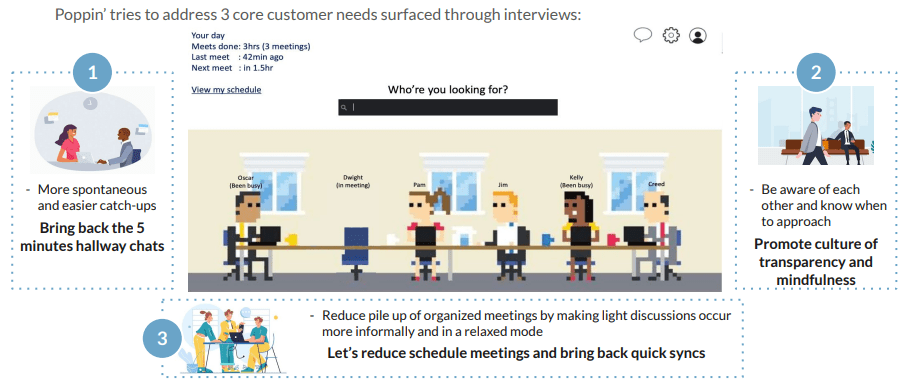
Spontaneous in-person interactions humanize workplace. Without them, jobs feels less transparent and less engaging. Work from home employees thus need to feel connected to succeed in the workplace.
In fact, highly engaged teams show 21% greater profitability, while disengaged employees cost U.S. companies up to $550 billion a year (Forbes)
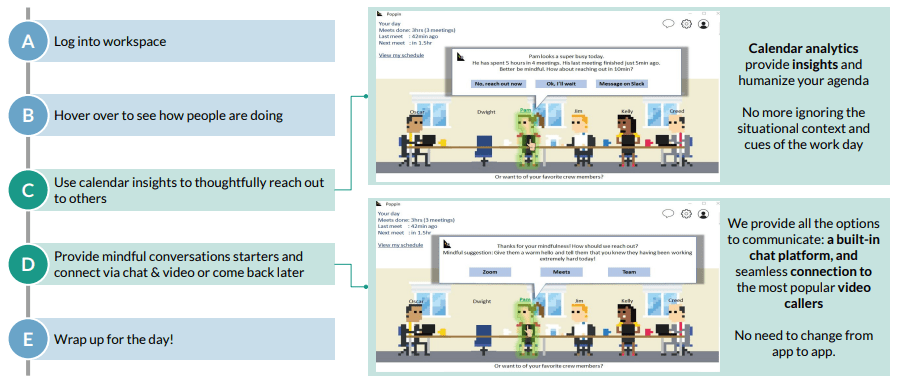
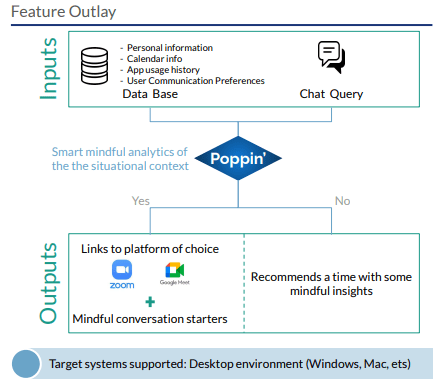
Phase 2: Solution (Enter Poppin’)

Phase 3: KPI and value generation
Key performance indicators should demonstrate impact on productivity and employee wellness. Therefore our basic KPIs would be as follows:

While there are some early movers in this space, only few have the product integrations and hardly any has a human-centered mindful recommendations that ensure the best user experience.
Therefore our product differentiation was based on:
- Providing a holistic experience by product integrations with zoom, slack, to give users a single window to handle all options
- Improving quality connection between colleagues providing a sense of empathy, awareness and careful judgement by developing a human-centered design via calendar analytics and mindful recommendations

And that’s Poppin’ for you!
 Aditya's Hideout